Published October 31, 2026.
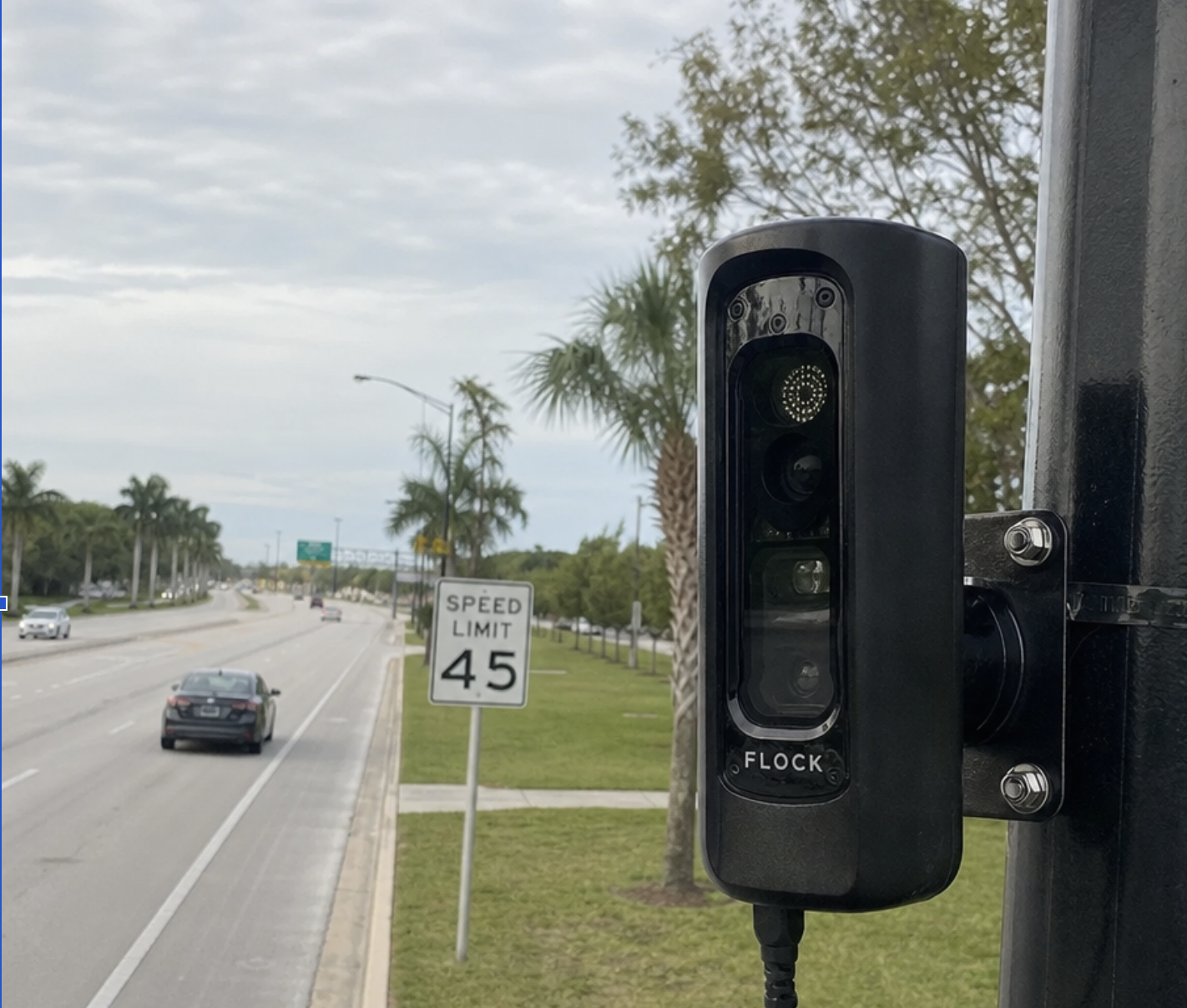
Flock cameras in Florida went from little-noticed police equipment to a statewide controversy in 2026. The Florida Department of Transportation ordered automated license plate readers off state highways, police officers were arrested for using them to track former partners, and South Florida cities split over what to keep. Here is what the cameras record, what the order did and did not do, what Florida law says, whether the cameras are constitutional, and how license plate reader data is used, and challenged, in criminal cases.
The Short Version
- On August 31, 2026, FDOT revoked all permits for automated license plate readers on state highway rights-of-way and gave agencies 30 days to remove them. FDOT will deny future requests.
- The order covers only state roads. Cameras on county roads, city streets and private property were not affected, so many Florida license plate readers remain.
- In Broward, Pembroke Pines shut off all of its more than 100 license plate cameras, while Sunrise, Coral Springs, Coconut Creek and Lighthouse Point were unaffected because their cameras were not on state roads. Miami Beach's mayor led a letter asking the state to pause the order.
- Misuse drove the debate. A Haines City officer was arrested after 717 searches of his estranged wife's car over nearly two years.
- In August 2026, Flock cut its default data retention from 30 days to 7 days and announced mandatory audits, automatic lockouts and case codes.
- Florida law makes license plate reader data containing personal information confidential, limits state-road cameras to criminal investigations, and requires a maximum retention period. A federal court upheld Norfolk, Virginia's Flock cameras in January 2026, but warned the answer could change.
- In a criminal case, plate reader data can be evidence against you or for you. Because data may be kept for as little as 7 days, a defense lawyer may need to act quickly to preserve it.
In this article
- Why Flock Cameras Came Down From Florida State Roads
- What a Flock Camera Records, and What It Does Not
- South Florida After the Order
- The Public Safety Case
- The Misuse Problem
- What Flock Changed
- What Florida Law Says About License Plate Readers
- Are Flock Cameras Constitutional?
- Flock Data in Criminal Cases
- What Comes Next
- Questions and Answers
Why Flock Cameras Came Down From Florida State Roads
On August 31, 2026, the Florida Department of Transportation issued Engineering and Operations Memorandum 26-01 revoking the general use permits that had allowed law enforcement agencies to install automated license plate readers on state highway rights-of-way. Agencies were given 30 days, until September 30, to remove them, after which FDOT said it would remove any devices still standing, and FDOT will deny future requests. (LkldNow; CBS12) The memo cited the "exponential increase" in deployments, reports of misuse, data privacy concerns and "surveillance schemes." (LkldNow)
Governor Ron DeSantis had criticized the technology in the days before the order, saying, "I don't want to have this become a surveillance state," and calling for legislation. (LkldNow; WSVN) Law enforcement leaders pushed back. Polk County Sheriff Grady Judd, while complying, called for statewide rules on privacy, auditing and accountability, and Palm Beach County Sheriff Ric Bradshaw called the readers "indispensable." (LkldNow; CBS12)
| Covered by the FDOT order | Not covered |
|---|---|
| Plate readers on state highway rights-of-way: interstates, U.S. highways and state roads | Cameras on county roads and city streets |
| Existing permits (revoked) and future requests (denied) | Cameras on private property, such as shopping centers and gated communities |
| Red-light cameras, school-zone speed cameras and school-bus stop-arm cameras (Sun-Sentinel via GovTech) |
Flock's chief executive responded that an outright ban would be "like banning vehicles." (FOX 35) The scope of the order is why Floridians still see license plate cameras at neighborhood entrances, on city streets and in parking lots.
What a Flock Camera Records, and What It Does Not
An automated license plate reader is, in Florida's statutory words, a system of cameras "combined with computer algorithms to convert images of license plates into computer-readable data." (section 316.0777) Flock's cameras photograph passing vehicles and log the plate along with vehicle characteristics such as make, color and distinctive features, and the time and place. Agencies run the plates against hot lists of stolen vehicles, wanted persons and missing persons, and can search the stored records later.
- Not a speed or red-light camera. Florida law says a plate reader on a state road may not be used to issue a traffic citation. (section 316.0777(2))
- Not facial recognition, though the vehicle photo can show occupants in some conditions.
- Not a name, by itself. A Senate analysis notes that stored plate reader data does not include the owner's personal information; that requires a separate, authorized query of another database. (Senate bill analysis, SB 1080 (2026))
Red-light cameras are a different program with different rules. For those, see our article on the Florida red-light camera ruling.
South Florida After the Order
The South Florida Sun-Sentinel reported that several Broward departments planned to remove only the cameras needed to comply. Pembroke Pines chose to shut off all of its more than 100 license plate cameras. Sunrise, Coral Springs, Coconut Creek and Lighthouse Point were not affected because their cameras were not on state roads. Many departments use other vendors, such as Axon, Rekor or Motorola Solutions, alongside or instead of Flock. A Broward Sheriff's Office spokesperson said the technology "simply automates" what officers have always done. (Sun-Sentinel via GovTech)
In Miami-Dade, Miami Beach Mayor Steven Meiner sent a September 1 letter, co-signed by the mayors of Aventura, Sunny Isles Beach, Bal Harbour, Bay Harbor Islands, Golden Beach and Indian Creek Village, asking the Governor and FDOT to pause enforcement and create a process for continued use under state oversight with audits. (Caribbean National Weekly)
The Public Safety Case
Agencies credit plate readers with solving serious crimes. The Tampa Police Department, which removed 17 readers from state roads, said its readers had contributed to 622 arrests, 485 recovered vehicles, 68 recovered firearms and 14 located missing persons since 2021. (Tampa Monitor) Readers also helped track an Indian River County murder suspect who was found in West Virginia. (CBS12) Flock says its system detected more than 1,000 missing people and more than 20,000 stolen cars nationwide in July 2026 alone. (Flock) Supporters say the speed of a plate hit, minutes after a crime or an Amber Alert, is something no canvass can match.
The Misuse Problem
The case against the cameras is not only theoretical. In August 2026, a Haines City police officer was arrested after an affidavit said he ran 717 Flock searches on his estranged wife's car between September 2024 and June 2026, on and off duty. He was charged with offenses against users of computers and official misconduct, and the department added quarterly checks on system use. (FOX 35) Reports also described a Sarasota officer accused of searching one plate about 350 times outside any investigation, and a former Sumter County detective charged after using Flock and other databases to gather information on her husband's former wife. (LkldNow) These are allegations, and the officers are presumed innocent.
The deeper concern is scale. One camera records a car passing a point. A network of thousands can show where a car goes to work, worship, see a doctor or spend the night. Most cars photographed have nothing to do with any crime.
What Flock Changed
On August 13, 2026, Flock announced changes in response to the misuse reports (Flock; Police1):
| Change | What it does |
|---|---|
| 7-day default retention | Recommended and default retention drops from 30 days to 7. Agencies may still choose longer, approved periods. |
| Evidence Mode | Lets investigators preserve specific records for an active case before they expire. |
| Mandatory Audit Assistance | Flags abnormal searches, such as repeated searches for one plate, for administrator review. Required for all law enforcement customers by the end of 2026. |
| Proactive lockouts | Automatically suspends a user whose activity meets abnormal-behavior criteria, pending review. |
| Case codes | Required for law enforcement searches by the end of 2026; emergency searches can bypass but are flagged. |
| Other | Mandatory multi-factor authentication and an outside security review. |
These are company policies, not law. Whether they are followed depends on each agency.
What Florida Law Says About License Plate Readers
- Purpose and placement. A law enforcement agency may ask FDOT to allow a reader on a state highway right-of-way to collect active criminal intelligence or investigative information, at FDOT's discretion, and must remove it within 30 days of FDOT's notice. That is the authority FDOT used in 2026. (section 316.0777(2))
- Confidentiality. Images and data containing personal identifying information obtained through a plate reader are confidential and exempt from public records disclosure. They may be shared with criminal justice agencies, and a person may obtain information about a plate registered to him or her unless it is part of an active criminal investigation. (section 316.0777(3), (4))
- Retention. The Department of State must set a maximum retention period for plate reader records. (section 316.0778) A Senate analysis says the current schedule allows retention for no longer than three years unless otherwise required. (SB 1080 analysis)
- Private cameras. Florida law has said little about plate readers run by private businesses and neighborhoods. Bills filed in 2026 proposed rules for private-property readers, including limits on sharing and a 30-day deletion requirement. (SB 1080 analysis; SB 1274 analysis) The Governor has called for new legislation on the subject.
Are Flock Cameras Constitutional?
The Fourth Amendment question is whether a network of plate readers adds up to a search that requires a warrant. In 2018 the Supreme Court held that police generally need a warrant to obtain a person's historical cell phone location records, because they reveal "the whole of his physical movements." (Carpenter v. United States, 585 U.S. 296 (2018)) Plate readers capture far less, only the moments a car passes a camera, but the more cameras there are, the closer they come to that picture.
The first major test came in Norfolk, Virginia, where residents represented by the Institute for Justice challenged the city's 176 Flock cameras. On January 27, 2026, a federal judge ruled for the city, finding the cameras did not continuously track people or capture enough data to reconstruct their routines, while writing that as the number and capabilities of cameras grow, "the constitutional balancing could conceivably tip the other way." His answer was "not today." The plaintiffs said they would appeal. (WHRO) No Florida appellate court has squarely decided the question.
Flock Data in Criminal Cases
As a reason for a traffic stop
A plate reader hit is often the reason for a stop: a car flagged as stolen, a plate tied to a warrant, or a registered owner with a suspended license. The Supreme Court has held that an officer may stop a car when the registered owner's license is revoked, absent information that the driver is someone else. (Kansas v. Glover, 589 U.S. 376 (2020)) But a hit is only as good as the data. Misread plates, out-of-state plates read as Florida plates, and stale hot-list entries can produce stops with no lawful basis, and evidence from an unlawful stop can be suppressed. Many DUI and drug cases begin this way. (See What Counts as DUI in Florida?)
As evidence of where a car was
Prosecutors use plate reader records to place a vehicle near a crime scene or along a route. The records show a car, not a driver. Who was driving, whether the read was accurate, whether the timestamp and camera location are reliable, and whether the search that produced the record was authorized and logged are all fair questions. Audit logs, the case code used, and the agency's own policies may be discoverable.
As evidence for the defense
Plate reader data can also show that a car was somewhere else. But with retention as short as 7 days at many agencies, it may be deleted before charges are filed. A defense lawyer may need to send preservation requests or seek a subpoena quickly, and should ask whether an agency used Evidence Mode to keep only the records that help the State. For more on electronic evidence, see our article on digital evidence.
What Comes Next
- Legislation. The Governor and law enforcement leaders have both called for statewide rules. Expect proposals on retention, auditing, private-sector cameras and penalties for misuse in the next legislative session.
- Local decisions. City commissions, sheriffs, homeowners associations and businesses will continue to decide on cameras off state roads, so the map will keep changing.
- Courts. The Norfolk appeal and any Florida suppression rulings will shape whether broader plate reader networks require warrants.
For anyone stopped, searched or charged after a plate reader hit, the questions are concrete: what triggered the alert, was it accurate, who searched the data and why, and what records still exist.
Questions and Answers
Are Flock cameras banned in Florida?
No. FDOT revoked permits for plate readers on state highway rights-of-way and will deny new requests there. Cameras on local roads and private property are not covered. (LkldNow)
Why were Flock cameras removed from Florida state roads?
FDOT's memo cited rapid expansion of the cameras, reports of misuse, data privacy concerns and surveillance concerns. (LkldNow)
How long does Flock keep license plate data?
Flock's default retention is now 7 days, though agencies may choose longer approved periods. Florida's records schedule sets an outer limit. (Flock; SB 1080 analysis)
Can I find out whether a Flock camera recorded my car?
Florida law allows a person to obtain plate reader information about a plate registered to him or her, unless it is part of an active criminal investigation. (section 316.0777(4))
Can police stop me because of a license plate reader alert?
Often yes, if the alert gives reasonable suspicion, such as a stolen car or a registered owner with a revoked license. (Kansas v. Glover) An inaccurate or outdated alert may not, and evidence from an unlawful stop can be challenged.
Do Flock cameras give speeding or red-light tickets?
No. Florida law says a plate reader on a state road may not be used to issue a traffic citation. (section 316.0777)
Alan S. Bernstein has defended people accused of serious crimes in South Florida since 1981, including sexual offense charges in state and federal court.
Stopped, Searched or Charged After a License Plate Reader Hit?
What you do in the first days matters. Call Alan S. Bernstein P.A. for a free, confidential consultation about a traffic stop, DUI or criminal charge in Broward, Miami-Dade, Palm Beach, Martin and Hendry counties.
Weekdays 954-925-3111 | Evenings and weekends 954-347-1000
Call 954-925-3111This article is general information about Florida law and publicly reported events as of October 31, 2026. It is not legal advice, and reading it does not create an attorney-client relationship. Every person charged with a crime is presumed innocent unless and until proven guilty, including the officers described above. Every case is different. A result in one case does not predict the result in another.
Sources
- Florida Statutes: section 316.0777 and section 316.0778; Florida Senate bill analyses, SB 1080 (2026) and SB 1274 (2026).
- LkldNow, Local law enforcement responds to FDOT order (Sept. 2, 2026); WSVN, FDOT orders removal of Flock cameras from state highways (Sept. 1, 2026); FOX 35, Flock cameras must be pulled from Florida state roads within 30 days (Aug. 31, 2026); CBS12, Florida ends permits for Flock cameras on state roads (Aug. 31, 2026); Tampa Monitor, TPD to remove 17 license plate readers (Sept. 1, 2026).
- South Florida Sun-Sentinel via GovTech, After Flock ban, these South Florida cameras will remain (Sept. 24, 2026); Caribbean National Weekly, South Florida mayors push back (Sept. 2, 2026).
- FOX 35, Haines City officer arrested for misusing Flock cameras (Aug. 11, 2026); Flock Safety, Flock guardrails (Aug. 13, 2026); Police1, Flock sets 7-day default for ALPR data (Aug. 14, 2026).
- WHRO, A federal judge ruled Norfolk's Flock cameras don't invade people's privacy, yet (Feb. 11, 2026); Carpenter v. United States, 585 U.S. 296 (2018); Kansas v. Glover, 589 U.S. 376 (2020).