Updated October 2026.
Walking a line and standing on one leg at the side of the road is how most DUI arrests are justified. Here is what the exercises can show, where they go wrong, and what Florida law says about declining them.
The Short Version
- Roadside exercises give an officer grounds to arrest. They do not prove a DUI.
- Only three are standardized: the eye test, the walk-and-turn and the one-leg stand. Finger to nose, balance, alphabet and counting exercises have never been validated.
- The government's own studies claim accuracy only when the exercises are given exactly as officers are trained, and even then between one decision in ten and one in twenty is wrong.
- Florida courts treat the walking and balance exercises as an officer's ordinary observations. Officers are not supposed to call them tests or say a driver passed or failed.
- Florida's implied consent law covers breath, urine and blood. It does not cover roadside exercises, so declining them does not suspend a license. A refusal can still be used as evidence.
In this article
- What the Exercises Are For
- The Three Standardized Exercises
- What the Accuracy Numbers Really Say
- The Exercises That Are Not Standardized
- Why Sober People Do Poorly
- The Eye Test
- How Florida Courts Treat Roadside Exercises
- Do You Have to Do Them?
- How Roadside Exercises Are Challenged
- Questions and Answers
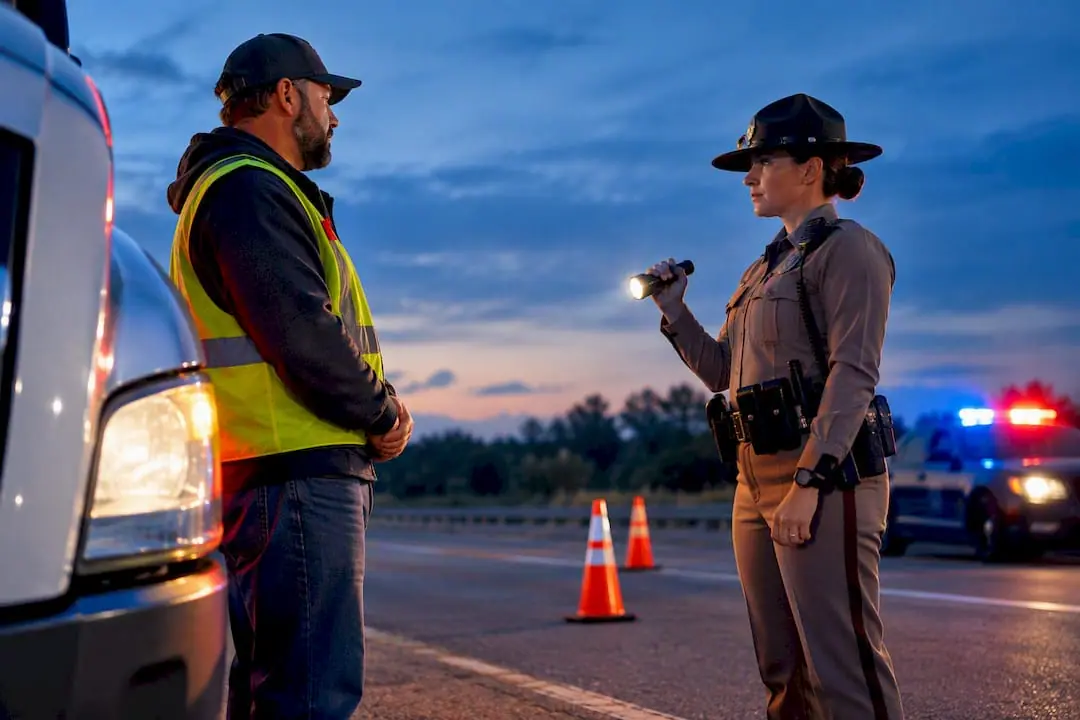
A driver is stopped late at night. The officer smells alcohol, asks a few questions and then says, "I'd like you to step out and do some exercises for me." What happens in the next ten minutes usually decides whether that driver goes home or goes to jail.
Most people assume these exercises are a scientific test with a right and a wrong answer. They are not. They are a set of balance and attention tasks, given at night on the shoulder of a road, and graded by the same officer who already suspects the driver. Understanding what they are, and what they are not, is the starting point for defending a DUI arrest.
What the Exercises Are For
Roadside exercises exist to help an officer make one decision: whether there is probable cause to arrest. Probable cause is a much lower standard than proof beyond a reasonable doubt, which is what the State needs for a conviction. An officer who is unsure will often arrest and let the court sort it out.
An officer does not need probable cause to ask for the exercises. In State v. Taylor, the Florida Supreme Court held that reasonable suspicion is enough: specific facts such as speeding, staggering, slurred speech and the smell of alcohol. If the officer had no reasonable suspicion, what followed can be challenged.
The Three Standardized Exercises
The National Highway Traffic Safety Administration (NHTSA) trains officers in three exercises it calls the Standardized Field Sobriety Tests. Its training manual says these are the only ones for which validated clues have been identified. (NHTSA, SFST Refresher Participant Manual)
| Exercise | What the driver does | What the officer counts |
|---|---|---|
| Horizontal gaze nystagmus (the eye test) | Follows a pen or a fingertip with the eyes while the officer moves it side to side. | Three signs in each eye, six in all: jerky tracking, distinct jerking at the far edge of the gaze, and jerking that starts before the eye reaches 45 degrees. Four or more is the decision point. |
| Walk-and-turn | Stands heel to toe while listening to instructions, then takes nine heel-to-toe steps along a line, turns in a prescribed way and takes nine steps back. | Eight clues: losing balance during the instructions, starting too soon, stopping, missing heel to toe, stepping off the line, using the arms to balance, turning improperly and taking the wrong number of steps. Two or more is the decision point. |
| One-leg stand | Raises one foot about six inches off the ground and counts out loud until told to stop, about 30 seconds. | Four clues: swaying, using the arms to balance, hopping and putting the foot down. Two or more is the decision point. |
Notice how little it takes. On the walk-and-turn, raising the arms for balance and missing heel to toe on one step out of eighteen is two clues. Under the scoring, that driver is treated as likely over the limit.
What the Accuracy Numbers Really Say
Prosecutors and officers often describe these exercises as scientifically validated. These are the figures behind that claim, all taken from NHTSA's own materials.
| Study | What it found |
|---|---|
| Original laboratory research | Used alone, the eye test was 77 percent accurate, the walk-and-turn 68 percent and the one-leg stand 65 percent. |
| Colorado field study, 1995 | Officers using the three exercises made the correct arrest or release decision 86 percent of the time. |
| Florida field study, 1997 | NHTSA's manual reports 95 percent correct arrest decisions. The study worked with the Pinellas County Sheriff's Office. |
| San Diego field study, 1998 | Officers' estimates at the 0.08 level were accurate in 91 percent of cases. By exercise: eye test 88 percent, walk-and-turn 79 percent, one-leg stand 83 percent. |
Four things about those numbers matter in court.
- They are about alcohol level, not driving. The studies asked whether an officer's guess matched a breath or blood number. None of them measured whether a person could drive safely.
- Even the best figures leave errors. At 91 to 95 percent, between one decision in ten and one in twenty was wrong. Some of the people on the wrong side of those numbers were under the limit.
- The officers were specialists. The San Diego study used seven officers from one city's alcohol enforcement unit and 297 drivers. A patrol officer who makes a few DUI arrests a year is not the same thing.
- The figures depend on doing it by the book. NHTSA's manual says the validation "applies only when the tests are administered in the prescribed and standardized manner." It adds that departures from ideal conditions may affect the weight the results deserve.
The Exercises That Are Not Standardized
Florida officers often add exercises of their own: touching a finger to the nose, standing with the eyes closed and the head tilted back, reciting part of the alphabet, counting backward or counting on the fingers.
None of these has a validated scoring system. NHTSA's manual says that the alphabet, counting and finger count techniques "have not been scientifically validated" and are not as reliable as the three standardized exercises. With no agreed list of clues, the result is whatever the officer says it was.
Why Sober People Do Poorly
The exercises are unfamiliar, the instructions are long and given once, and the setting is about as bad as it could be. Many sober people cannot stand on one leg for 30 seconds in their own living room.
What affects performance besides alcohol
- The surface. NHTSA's manual calls for a reasonably dry, hard, level, non-slippery surface. Road shoulders are sloped, cracked, gravelly and wet.
- The setting. Darkness, flashing patrol lights, headlights and traffic passing a few feet away.
- Age and health. The manual notes that in the original research, people over 65 and people with back, leg or inner ear problems had difficulty with the walk-and-turn.
- Footwear. The manual says a driver in heels more than two inches high should be offered the chance to take them off.
- Weight, fatigue and injuries. All of them affect balance.
- Nerves. Being investigated for a crime at the side of the road is frightening, and fear looks a lot like unsteadiness.
- Language and hearing. A driver who does not catch every instruction is scored as if he or she chose to ignore it.
The officer makes mistakes too. Instructions get shortened. The demonstration is skipped. The stimulus in the eye test is moved too fast or held too close. Ordinary behavior, such as a small sway or a pause, is written up as a clue. Each of those is a departure from the standardized procedure that the accuracy figures depend on.
The Eye Test
Nystagmus is an involuntary jerking of the eyes. Alcohol can make it more pronounced, and the eye test asks the officer to judge that jerking by sight, at night, at the side of a road.
The procedure is exacting. The manual sets the distance of the stimulus at 12 to 15 inches, the speed of each pass and how long the eye must be held at the edge of its range. Before starting, the officer is supposed to check for equal pupil size, for nystagmus when the eyes are at rest and for whether both eyes track together, because a difference can point to a medical condition or an injury. The manual also recognizes that nystagmus has causes other than alcohol, including brain injury, some inner ear disease and certain drugs.
Florida courts treat this exercise differently from the others. In State v. Meador, the Fourth District Court of Appeal held that the eye test is scientific evidence and should be excluded unless the State shows that the method is reliable, that the officer was qualified to give it and what the results mean. In Williams v. State, the Third District allowed it when a properly qualified officer gave it correctly, and held that it cannot be used to prove a specific alcohol level.
How Florida Courts Treat Roadside Exercises
This is why Florida lawyers and judges say "exercises" and not "tests." In Meador, the court held that the walking and balance exercises are admissible only as an officer's lay observations of how a person looked and moved. An officer may not attach more significance to them than to anything else he or she saw.
The court also said that witnesses should avoid the words "test," "pass," "fail" and "points," because those words give the exercises what it called an aura of scientific validity. When an officer tells a jury that a driver failed the field sobriety tests, the defense can object.
Do You Have to Do Them?
No Florida statute requires a driver to perform roadside exercises. The implied consent law covers breath, urine and blood tests after an arrest. (section 316.1932, Florida Statutes) It says nothing about walking a line.
| Declining roadside exercises | Refusing a breath test after arrest | |
|---|---|---|
| Driver's license | No suspension. | Suspended for 1 year, or 18 months for a second refusal. |
| Criminal charge | None. | A crime since October 1, 2025: a second-degree misdemeanor for a first refusal. |
| Use in court | A refusal can be used as evidence, at least where the driver was told there would be consequences. | The refusal is admissible. |
The last row comes from State v. Taylor. The Florida Supreme Court allowed a refusal to be used as evidence of consciousness of guilt where the driver understood the purpose of the exercises and had been told that refusing would have consequences. What the officer actually said before the refusal is one of the first things to check.
Declining does not end the encounter. The officer can still arrest on what he or she has already seen, and will then ask for a breath test, which carries its own consequences. This is general information, not advice for any particular stop.
How Roadside Exercises Are Challenged
Mr. Bernstein has lectured to other lawyers on field sobriety exercises, including training for the Broward County Public Defender's Office. In a DUI case he looks at:
- The video. Body camera and dash camera recordings are compared with the arrest report, clue by clue. The report often describes a worse performance than the video shows.
- The officer's training. When the officer was trained, on which edition of the manual, and how closely the instructions and scoring followed it.
- The conditions. The surface, the lighting, the weather, the traffic and what the driver was wearing.
- The person. Age, weight, injuries, medical conditions and medication, supported by medical records.
- The reason for asking. Whether the officer had reasonable suspicion to request the exercises, and probable cause to arrest afterward.
- What the jury hears. A motion before trial can limit the officer to lay observations, keep out the words "pass" and "fail," and exclude the eye test when the State cannot lay the foundation for it.
After any DUI arrest there are also only 10 days to request a formal review of the license suspension. See DUI Defense.
Questions and Answers
Are field sobriety tests mandatory in Florida?
No statute requires them. Declining does not suspend a driver's license and is not a separate crime. A refusal may be used as evidence, and the officer can still make an arrest based on other observations.
Can refusing the roadside exercises be used against me?
It can. The Florida Supreme Court has allowed a refusal to be used as evidence where the driver was told that refusing would have consequences. You remain free to explain the refusal at trial.
Can the eye test prove I was over 0.08?
No. A Florida appeals court has held that the eye test cannot be used to establish a specific alcohol level. Only a breath, blood or urine test can do that.
How accurate are field sobriety tests?
The government's field studies reported 86 to 95 percent correct decisions, with trained officers following the standardized procedure. Used alone, the individual exercises scored lower, and the figures do not apply when the procedure is not followed.
I am over 65, or I have a bad back or bad knees. Does that matter?
Yes. NHTSA's own manual acknowledges that older people and people with back, leg or inner ear problems had difficulty with the walk-and-turn in the original research. Tell the officer about any condition, and make sure your lawyer has the medical records.
Does the officer have to read me my rights first?
Generally not before the physical exercises. Miranda warnings apply to questioning in custody. Parts of some exercises that call for a spoken answer can raise the issue, and so can questions asked after an arrest.
If the exercises were done wrong, is the case dismissed?
Not automatically. Mistakes reduce the weight of the evidence and can lead a judge to limit or exclude it. Whether that ends the case depends on what other evidence the State has. No lawyer can promise a result.
Alan S. Bernstein is a criminal defense attorney who has practiced in South Florida for more than four decades, with a practice devoted largely to DUI defense.
Arrested After Roadside Exercises?
The video, the officer's training and the conditions at the roadside can all be examined. Call Alan S. Bernstein P.A. for a free consultation about a DUI charge in Broward, Palm Beach, Miami-Dade, Martin and Hendry counties.
Weekdays 954-925-3111 | Evenings and weekends 954-347-1000
Call 954-925-3111The information in this article is general and is not legal advice. Every case is different, and past results do not guarantee a future outcome. Contacting the firm does not create an attorney-client relationship.
Sources
- National Highway Traffic Safety Administration, DWI Detection and Standardized Field Sobriety Testing Refresher, Participant Manual (rev. Feb. 2023).
- National Highway Traffic Safety Administration, Standardized Field Sobriety Testing Refresher, Participant Manual (rev. Oct. 2015).
- J. Stuster and M. Burns, Validation of the Standardized Field Sobriety Test Battery at BACs Below 0.10 Percent, DOT HS 808 839 (1998).
- M. Burns and T. Dioquino, A Florida Validation Study of the Standardized Field Sobriety Test (S.F.S.T.) Battery (1997).
- State v. Taylor, 648 So. 2d 701 (Fla. 1995).
- State v. Meador, 674 So. 2d 826 (Fla. 4th DCA 1996).
- Williams v. State, No. 95-2476 (Fla. 3d DCA Mar. 18, 1998).
- Section 316.1932 and section 316.1939, Florida Statutes (implied consent; refusal).
Comment (1)
Breath Test Refusal Florida: First Refusal Now a Crime
says November 22, 2026 at 11:39 am[…] Notice also what the statute covers: a test of “breath or urine.” It does not say blood. And it refers to the test “as described in s. 316.1932,” which is the test requested after a lawful arrest, usually on the Intoxilyzer at the station or jail. Declining the walk-and-turn or the one-leg stand on the shoulder of I-595 is a different question, covered in our article on roadside sobriety exercises. […]
Comments are closed.