Originally published September 5, 2026. Updated October 2026.
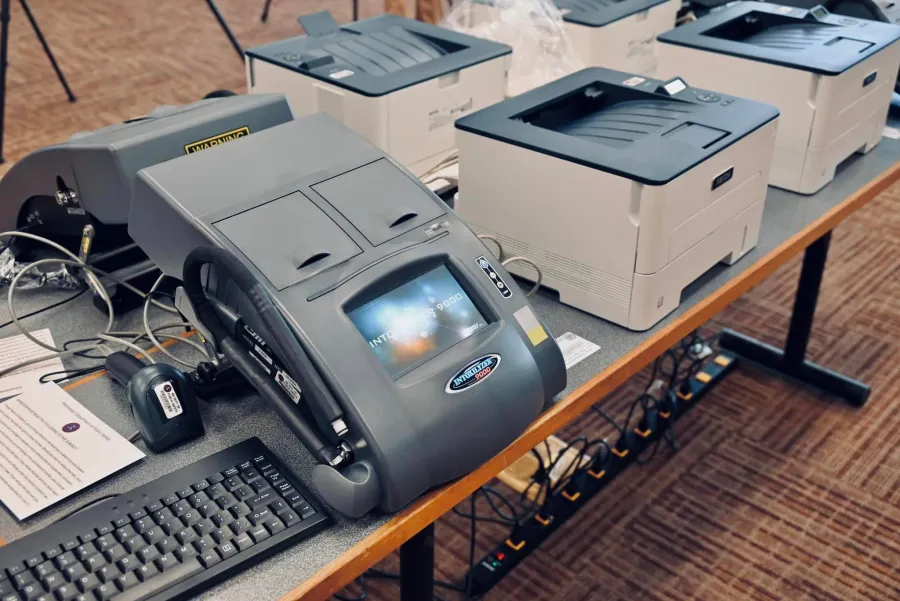
Florida is replacing the breath test machine it has used since 2006. The new one fixes some real problems, removes some safeguards, and arrives in the middle of a statewide changeover that creates questions of its own.
The Short Version
- The Florida Department of Law Enforcement is replacing the Intoxilyzer 8000 with the Intoxilyzer 9000, made by the same company, CMI, Inc.
- The 9000 has a better interface, better data handling and more detectors. It is also checked each month with dry gas only, has a narrower certified range, reports less detail when a sample is rejected, and is a sealed unit that agency inspectors may not open.
- During the changeover, agencies run both machines. The machine, the operator's permit and the inspector's permit all have to match.
- Florida courts threw out Intoxilyzer 8000 results in 2025 and 2026 because repairs were done by people the rules do not allow to do them.
- Since October 1, 2025, refusing a breath test is a crime in Florida, so more drivers will be tested on these machines.
In this article
If you are arrested for DUI in Florida this year, there is a real chance the machine measuring your breath is not the one defense lawyers have spent two decades learning to cross-examine. FDLE is in the middle of a statewide swap. It is retiring the Intoxilyzer 8000, in service here since 2006, in favor of the Intoxilyzer 9000. Agencies have been taking delivery of the new units and sending officers through new certification courses.
The State will present this as a simple upgrade: newer hardware, a touchscreen, better data transmission. Some of that is true. But a change of this size, with new hardware, a new training curriculum and agencies running old and new machines side by side, is exactly the kind of moment that raises questions the State has to answer.
Why This Matters More Now
Under Trenton's Law, which took effect on October 1, 2025, refusing a lawful breath test is a crime: a second-degree misdemeanor for a first refusal and a first-degree misdemeanor for a later one. (section 316.1939, Florida Statutes) That is on top of a one-year license suspension for a first refusal.
The practical result is that fewer people will refuse, and more cases will turn on a number produced by a machine. How far that machine can be trusted has never mattered more.
The 8000 and the 9000 Side by Side
These comparisons are drawn from FDLE's training materials for each instrument.
| Intoxilyzer 8000 | Intoxilyzer 9000 | |
|---|---|---|
| Display and data entry | Two-line text display and a keypad | Color touchscreen, barcode scanner and card reader |
| Sending results | Internal telephone modem | Ethernet and USB |
| Infrared detectors | Two | Four, each with its own filter |
| Monthly accuracy check | Liquid alcohol solutions, plus dry gas | Dry gas only |
| Reported range | Up to 0.600 | Certified from 0.020 to 0.300 |
| Rejected samples | Two messages: one for a falling reading, one for a rising one | One message for both |
| Agency inspector's role | Trained in basic hardware checks | May not open the unit |
What the 9000 Improves
To be fair to the new machine, several changes are real improvements over a design that dates to the mid-2000s.
- A modern interface. Scanning a license or a barcode cuts down on the typing mistakes, such as transposed numbers and wrong case numbers, that were common on the 8000's keypad.
- Better connectivity. Network and USB connections should mean faster and more reliable transfer of results to FDLE, and fewer lost or damaged data files.
- More detectors. Four infrared detectors instead of two should, in theory, give the machine a finer reading of what is in the breath sample.
- Better shielding. Interference from police radios and cell phones was a known weakness of the 8000. The 9000 is described as better shielded, although the interference error has not gone away.
None of that is trivial. But some of the changes that make the 9000 cheaper and faster to run also remove safeguards that gave both sides, and juries, more insight into whether a result could be trusted.
What the 9000 Changes for the Worse
It is checked against gas, not liquid
The 8000's monthly inspection used "wet bath" simulators: liquid alcohol solutions, warmed so that they give off vapor the way alcohol leaves the blood in a person's lungs. The 9000's monthly inspection uses only pre-mixed dry gas from a canister. Dry gas is cheaper and easier to standardize. It also means the monthly check no longer tests whether the machine reads alcohol vapor rising off a warm liquid, which is the physical process a breath test is supposed to measure.
Its certified range is narrower
The 8000 reported results up to 0.600. The 9000 is certified from 0.020 to 0.300, and flags anything above that as outside its calibration range. Florida's enhanced DUI penalties begin at 0.15, well inside that range, so this matters mainly for very high readings. In those cases the question is what the State can prove about a number the instrument itself says it cannot vouch for.
It says less when something goes wrong
The 8000 gave one message when a sample's reading was falling and a different one when it was still rising. The difference mattered: a reading that keeps climbing without leveling off is a classic sign of alcohol in the mouth, not air from deep in the lungs. The 9000 uses a single message for both. Less information reaches the printout, and there is less for either side to work with in understanding why a sample was rejected.
Inspectors are trained to know less about the hardware
The 8000 curriculum taught agency inspectors basic hardware checks, such as fuses and the printer. The 9000 curriculum bars inspectors from opening the unit at all. That lowers the risk of an officer damaging something. It also means the person who certifies the machine as reliable, and may testify to that in court, is trained to operate a sealed box, not to understand what is happening inside it.
The old problems are still there
- Mouth alcohol. Acid reflux or a burp can bring alcohol from the stomach into the mouth and raise a reading. The machine is designed to detect this, but no detection method is foolproof. This is why the operator must make sure the person has had nothing by mouth and has not regurgitated for at least 20 minutes before the test.
- Chemicals in the room. Hand sanitizer or cleaning products used near the instrument can cause an ambient-air failure.
- Radio interference. Radios and phones can still trigger an interference error.
The Changeover Is Its Own Source of Error
The training courses and permits for the two machines are not interchangeable, and each machine has its own forms. While agencies run mixed fleets and officers work through new training, there is more room for a mismatch between the machine that was used and the paperwork that supports it.
During the changeover, confirm
- Which instrument was used, by model and serial number.
- That the operator held a valid permit for that model on that date.
- That the agency inspector who performed the monthly inspection held a valid permit for that model.
- That the inspection and test paperwork is on the forms for that model.
Florida Has Been Here Before
This is not Florida's first fight over what is inside a CMI machine. In 2005, when the State relied on the Intoxilyzer 5000, a Sarasota County court ordered the State to give a defense expert access to the machine's source code, after changes had been made to its software. (State v. Bjorkland)
State v. Kilburn: a repair is not maintenance
On August 15, 2025, the Second District Court of Appeal decided State v. Kilburn. An FDLE inspector had replaced a leaking, broken breath tube on an Intoxilyzer 8000, a job that involved removing the top panel and disconnecting wiring. FDLE's rules allow only the manufacturer, or a facility the manufacturer has authorized, to repair a breath instrument. The trial court found that the tube replacement was a repair, not maintenance, and suppressed the breath results of three defendants tested on that machine. The appeals court left that ruling in place and rejected the State's argument that it had substantially complied with the rules.
Jacksonville, August 2026: the O-ring ruling
On August 12, 2026, a three-judge panel of the Fourth Judicial Circuit, which covers Duval, Clay and Nassau counties, suppressed a breath result on similar reasoning. According to press reports, the panel found that O-rings inside Intoxilyzer 8000 units had been replaced without records being kept, and treated that work as an unauthorized repair. The State Attorney's Office there said about 950 pending cases were under review. (Jax Today; News4JAX)
The State's side should be noted. The Jacksonville Sheriff's Office has said that all repairs are done through an approved repair facility. The State Attorney's Office has said that no cases had been reduced or dismissed for this reason and that it would show the results are scientifically reliable.
What that means for the 9000
The problem in those cases was possible because people in the field had their hands inside the machine. The 9000's sealed design closes that particular door. With no field repair left to mislabel as maintenance, a malfunctioning 9000 should have to go back to CMI or an authorized facility, which is what Florida's rules already required.
That deserves some skepticism as a fix. An inspector who cannot open the box also cannot evaluate what is wrong with it. A sealed unit does not stop an agency from being tempted to keep a failing machine in service. It changes what the defense has to ask for. If the same pattern shows up on the 9000, it is more likely to appear as a repair history that does not match the machine's records, or as a unit that should have locked itself out of service and did not, than as a part swapped in the field.
How Other States Have Fought Breath Test Machines
Florida is not the only state to confront a "trust the box" instrument. What has worked elsewhere depends heavily on each state's rules of evidence.
New Jersey. In State v. Chun (2008), the New Jersey Supreme Court sent the case back so that independent software firms, one chosen by each side, could analyze the source code of the Alcotest 7110, which its maker had at first refused to disclose. The two reviews reached different conclusions. The court found the machine generally reliable, but it ordered software corrections, recalibration every six months and other changes before results could be used.
Minnesota. In State v. Underdahl, 767 N.W.2d 677 (Minn. 2009), the Minnesota Supreme Court upheld an order requiring the State to produce the source code of the Intoxilyzer 5000EN for a defendant who had shown why it mattered to his defense. The machine was made by CMI, the same company that builds Florida's 8000 and 9000.
Washington. After Washington adopted the Alcotest 9510, two researchers who were given access to its source code under a court's protective order reported flaws they said could affect results. Their final report was never completed. The manufacturer accused them of violating the protective order, and the dispute was settled with both sides agreeing that the draft was incomplete. (CBS News, May 10, 2018) Winning access to the code does not guarantee a finished, usable analysis.
North Carolina. North Carolina uses a different machine and has a statute that makes breath results admissible when the test follows state health department rules. A statute like that blunts the practical value of a source code challenge.
The lesson for Florida is not that source code litigation is automatically the right move. Florida's evidence rules are its own, and that kind of fight is a major undertaking. The lesson is that courts have been willing to look inside these machines, and that what they found has sometimes led to changes.
What to Check in a Breath Test Case
A number on a printout can look final. It is not. Whichever machine was used, these are the records that show whether the result deserves to be trusted.
What the defense looks at
- The breath test affidavit, which identifies the instrument and the operator.
- The operator's and the agency inspector's permits, for that model, on that date.
- The agency's monthly inspections and FDLE's own periodic inspection of that instrument.
- For a 9000: the dry gas standard that was used, including its lot and expiration date.
- The 20-minute observation period, and any video of it.
- Every message the instrument produced during the test, including rejected samples.
- The instrument's full repair and maintenance history, and who did the work.
- Whether the instrument was ever locked out of service, and why.
After any DUI arrest, there are also only 10 days to request a formal review of the license suspension. See DUI Defense.
Questions and Answers
How do I know which machine was used in my case?
The breath test affidavit and the printed result identify the instrument by model and serial number. Those documents are part of what the State must turn over.
Is a result from the 9000 more reliable than one from the 8000?
Not automatically. The 9000 is newer and better in some respects, and weaker in others. In any one case, reliability depends on that instrument's records, the operator and how the test was run.
Can I still refuse a breath test?
You can, but since October 1, 2025 a refusal is a crime in itself, in addition to a license suspension, and the refusal can be used as evidence. Whether to take the test is a decision with consequences either way.
Do the Kilburn and Jacksonville rulings help someone arrested in South Florida?
They can. Kilburn is an appellate decision that courts elsewhere in Florida can be asked to follow. The Jacksonville ruling comes from a circuit court panel in another part of the state, but it shows how the argument is developing. Either one matters only if the records for the instrument in your case show the same kind of problem.
Does a breath result over 0.08 mean a conviction?
No. A result is evidence, not a verdict. The State has to show the test was done in substantial compliance with FDLE's rules, and a jury decides what weight to give it. No lawyer can promise an outcome.
Alan S. Bernstein is a criminal defense attorney who has practiced in South Florida for more than four decades, with a practice devoted largely to DUI defense.
Arrested for DUI on a Breath Test?
Whether the machine was an 8000 or a new 9000, the records behind the number can be examined. Call Alan S. Bernstein P.A. for a free consultation about a DUI charge in Broward, Palm Beach, Miami-Dade, Martin and Hendry counties.
Weekdays 954-925-3111 | Evenings and weekends 954-347-1000
Call 954-925-3111DUI Defense · DUI Manslaughter · DUI Serious Bodily Injury · Contact
The information in this article is general and is not legal advice. Every case is different, and past results do not guarantee a future outcome. Contacting the firm does not create an attorney-client relationship.
Sources
- Section 316.1939, Florida Statutes (refusal to submit to testing; penalties).
- Florida Administrative Code, Chapter 11D-8 (FDLE Implied Consent Program).
- FDLE Alcohol Testing Program, operator and agency inspector training materials for the Intoxilyzer 8000 and Intoxilyzer 9000.
- State v. Kilburn, Nos. 2D2024-0649, 2D2024-0652 and 2D2024-0722 (Fla. 2d DCA Aug. 15, 2025).
- Jax Today, report on the Fourth Judicial Circuit breath test ruling (Sept. 2, 2026).
- News4JAX, report on the Jacksonville breath test ruling (Sept. 3, 2026).
- State v. Bjorkland, No. 2004 CT 014406 (Fla. Sarasota Cty. Ct. Nov. 2, 2005).
- State v. Chun, 194 N.J. 54 (2008).
- State v. Underdahl, 767 N.W.2d 677 (Minn. 2009).
- CBS News, report on the Alcotest 9510 source code review (May 10, 2018).